Christ the King Sunday
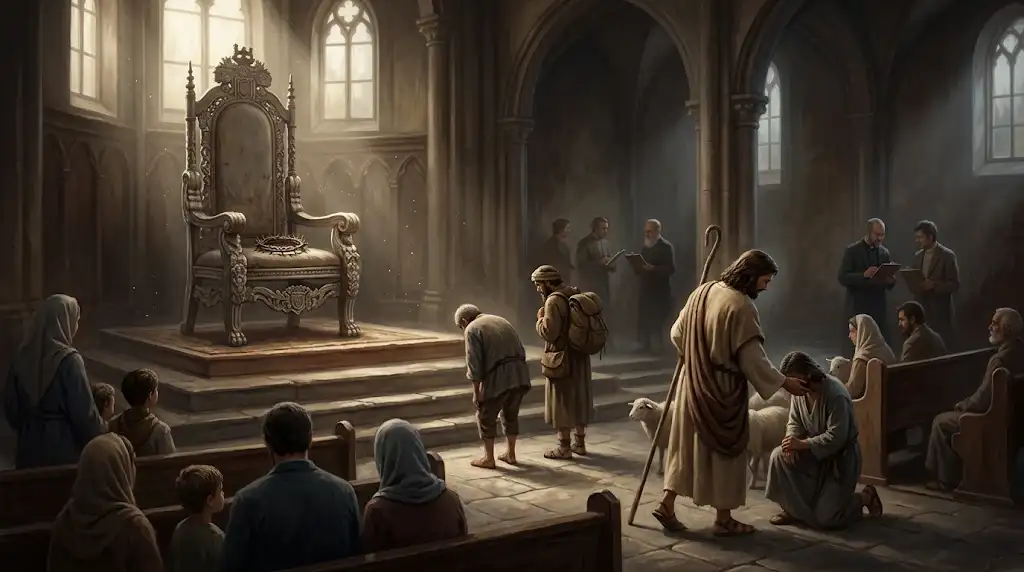
The Empty Throne
Ezekiel 34:11–16, 20–24
A Christ the King Sunday reflection on Ezekiel 34:11–16, 20–24: emptying the church's throne of ego and ambition so Christ alone reigns as King and Shepherd.
Abstract
There are times when the church is too busy to remember who owns it. People arrive. Songs of praise and worship are sung. Ministry programs are organized. Numbers are announced. Leaders speak of growth. Yet in the midst of all that movement, a question may be left lingering in the corner of the room: Who is actually sitting on the throne here?
We call the church the Body of Christ. Yet a body, much like an institution, can be driven by another will. Personal ambition. Group interests. The anxiety to be big, crowded, and visibly successful.
Christ is still called King, though perhaps only in song.
Ezekiel speaks from the midst of the shepherds’ failure. They were given a flock, yet they cared only for themselves. They knew power, yet forgot compassion. So God comes with a shattering decision: “I myself will search for my sheep and look after them.”
There is something stirring in that word “myself.” It is as if the Lord is saying: when the watchmen fail to keep watch, I will walk the streets. When the lost are no longer sought, I will search for them. When wounds are treated as an inconvenience, I myself will bind them up.
The Lord does not wait for the straying sheep to find its way home. He goes after it.
Perhaps that is where the church must begin again: not with a new program, but with a heart willing to seek. For the church is not a place for perfect people to display their piety. It is a home where the weary may knock without fear of being shamed.
Yet even a home can have a narrow door for certain people. Some are welcomed for their name. Some are heard for their position. Some are respected for their wealth. Meanwhile, those without a voice learn to sit quietly in the back row.
Ezekiel speaks of the fat and strong sheep. They shove with flank and shoulder, butt the weak with their horns, and muddy the water meant for the rest of the flock to drink.
Violence, it seems, does not always arrive with shouting. Sometimes it lives in a community that never makes room. In decisions always made by the same people. In hospitality extended only to those deemed important. The Lord sees it all.
He stands between the strong sheep and the weak, and declares that He will judge with justice.
Justice, in the Lord’s flock, does not mean the strong are forbidden from being strong. They are simply asked to redefine strength. Not as the ability to dominate, but as the courage to uphold. Not as the right to go first, but as the willingness to make space.
Perhaps the maturity of a church is not primarily seen in the size of its building or the crowd at its events. Perhaps it is visible in quieter things: Do the wounded feel safe to come? Are the poor still regarded with dignity? Are those who have failed still given a way home?
Then the Lord promises to place one shepherd over them. One! Not because the church needs only one powerful person, but because the flock has only one center. Pastors, elders, and ministers are not called to build little thrones. They are called “servants.”
It is a simple word, yet not always easy to accept. For a title can make someone forget they were once called to wash feet. Ministry can turn into a stage. Influence can be mistaken for ownership.
Yet no one can say, “This is my congregation,” without first hearing Christ say, “They are Mine.”
The unity of the church is not born because everyone thinks alike. Unity is born when no one tries to replace the Shepherd.
Before Him, differences need not become divisions. Gifts need not become rivalries. Ministry is no longer a subtle way to make a name for oneself.
Christ the King Sunday invites us to look again at that throne. Is Christ truly seated there? Or has His name merely become a symbol covering our ambitions?
Perhaps the repentance of the church begins when we dare to empty the throne of everything that is not Christ. Of ego. Of factionalism. Of the desire to win for ourselves. Of a measure of success that counts the crowd, yet fails to recognize the weeping.
The King proclaimed by Ezekiel is not a king who dwells far away in a palace. He walks in search of the lost sheep. His hands touch the wounds. His eyes find the unseen. His power is present as protection for the weak.
Therefore, the church led by Him ought to bear the same face. Not a face quick to judge, but one willing to listen. Not a hand that points in accusation, but one that binds up wounds. Not a voice that exalts itself, but one that calls the lost back home.
In the end, the church is not asked to become an impressive kingdom. The church is called to be a flock that knows the voice of its Shepherd. And perhaps only when we have emptied all our little thrones can we honestly say once again: Christ is King. This church belongs to Him. Amen!

Tags
Discussion
Comments